-
 35+ Years Experience
-
 Society of Gilders Member
-
 VCA
Postgraduate -
 International Clientele
An entry gate stands in the weather for years before anyone thinks of gilding it. By then the surface has a history: old paint, corrosion in the places water sits, and a hinge that has moved a thousand times. None of that is the leaf’s problem to solve. It is mine, and it gets solved before any leaf comes out of the book. That is what metal gilding turns on, whether the object is a gate, a balustrade, a sculpture or a piece of architectural ironwork indoors. I am Marcus Walkley, and I have laid leaf onto other people’s metalwork for 36 years, including the polished external pure gold on a wrought iron entry gate in Toorak.
What is already on the metal
Every piece of metalwork I am asked about arrives carrying something. One gate has been painted five times, another was powder coated once and left alone, a third has never had anything on it at all. A sculpture that has spent its life in a room is a different proposition again.
Leaf hides nothing. Laid over a surface that is pitted, flaking or still moving, it reports all of it back to you in the first raking light that crosses it. So the questions I ask come before any question about which metal goes on top.
What the object is made of, first. Wrought iron, mild steel, bronze, brass and aluminium all take leaf, and they do not all take it the same way. What is on the surface now, second: paint, powder coating, an older gild, or bare weathered metal. And whether corrosion is active anywhere, because gold laid over rust that is still working is money spent on a countdown.
Then movement. A gate swings, a balustrade gets leaned on, and metal in the sun is not the size it was at dawn. A finish specified for a surface that moves is a different brief from one specified for a plaster ceiling that never will, and that difference decides most of what I end up recommending.
Outside, gold is the only leaf I will specify
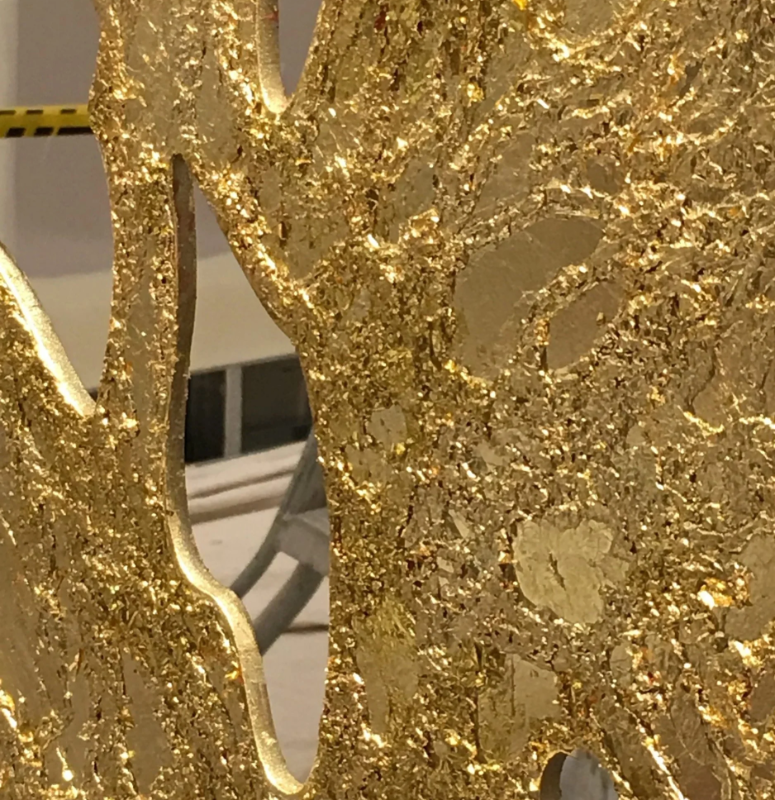
If the surface lives outdoors, the material decision is largely made for you. Gold does not tarnish and does not corrode, and it will hold its colour on a gate with nobody attending to it. Silver and copper both move, and they move faster in open air than they ever would in a room. So gilding exterior wrought iron means gold, and I have no second answer I would put my name to.
The method follows from the same fact. Water gilding wants a prepared ground and a burnish, and neither one belongs on something that spends winter outside. Exterior metal is oil gilded: the leaf goes down into an oil size that tolerates weather and movement, and the finish it leaves is an even lustre, not a polished one.
The clearest example I have is an entry gate in Toorak. Polished external pure gold, gold leaf laid onto wrought iron, out in the open from the day it went back on its hinges. Unlike paint, the gold will never lose its lustre or elegance.
Working outdoors also changes how the job runs. The gate has to keep opening while I am there. Leaf goes down in the conditions the day gives you, not the ones written into a programme, and a still morning is worth more than a booked afternoon. Where an element cannot come off its footing, the work travels to it, which makes access the first thing to settle on a job like that.
Composition leaf and imitation leaf, and where they belong
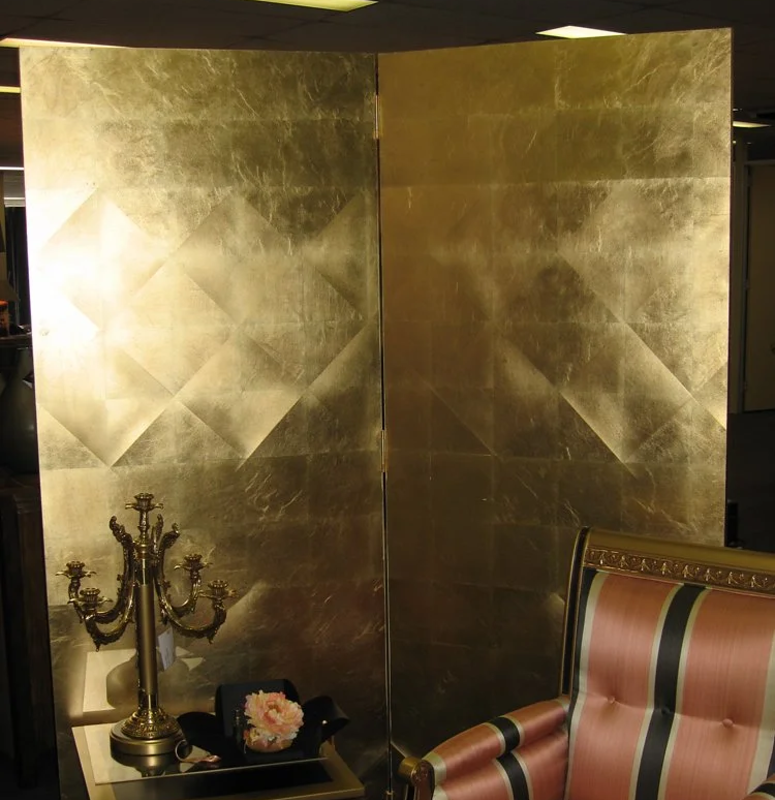
You do not always need precious metal. Composition and imitation leaf are made to look like gold or silver without being either, they are sold in sheets, and they are laid by much the same hand movements. The question is never whether they exist. It is where they are the right call.
Indoors, in a protected position, on a scheme that will be reworked before long, or across an area whose sheer size is the real constraint, imitation leaf can be a sensible specification. I would far rather be asked about it early than told about it late.
Where it is the wrong call is anywhere the weather gets to, and anywhere the surface will be expensive to reach a second time. Base metal is not gold and does not behave like it, so putting it outside buys a saving now and a return visit later.
What matters more than either is the naming. If a finishes schedule says gold leaf, gold leaf is what should arrive, and if the budget has decided otherwise the schedule should say so in writing.
Architects and conservators read these documents, and they can tell the difference standing in front of the surface. So can the client, eventually. Better it is a decision than a discovery.
Balustrades, sculpture and the ironwork indoors
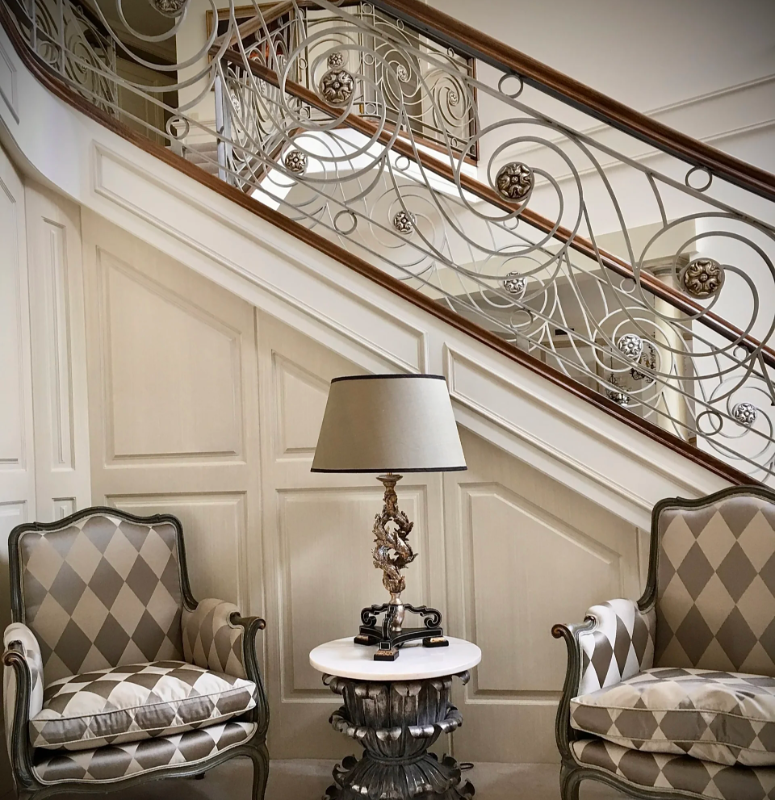
Inside the building the exposure question relaxes and the choice opens up. Architectural ironwork covers a great deal: balustrades and stair strings, screens and grilles, handrails, door furniture, light fittings, and sculpture that was never going to be anything but metal. The metallic finishes worth considering on those elements are broader indoors than out, because the room is stable and nothing is working on the surface from the outside.
Silver and copper come back into play here. Both still move, as they do on any substrate, but indoors that movement is slow enough that you can specify for it.
Two things narrow it again. Anything people touch all day asks a different question from anything they only look at, and a handrail is where that shows fastest. And anything at height carries the cost of getting back up there, which is the argument for laying a metal that will not need revisiting.
Architectural element gilding and sculpture gilding both sit among the services I offer, and on this kind of work they land on metal more often than not. A good deal of it is in my commercial portfolio.
Who you get when you commission Walkley Art for metalwork
I have been laying leaf for 36 years, and I oversee every commission myself. The work goes out under my own name on a gate the same as on a ceiling.
Jennifer Bennell taught me the gilding, at the Studio of Painted Finishes in Sydney. The art training came before that: a Diploma of Fine Art at Prahran Technical College, then postgraduate study in Fine Art at the Victorian College of the Arts. I am a member of the Society of Gilders. I teach the craft as well, through my gilding classes. That is a proof of its own kind. You cannot teach a hand movement you have not settled for yourself.
Metalwork also puts me where a plaster ceiling does not, which is on an elevated work platform, in the open air, alongside other trades on a live building. That part is professional work before it is decorative work, and it carries the cards to match: a Work Safe OH&S White Card and an EWPA Yellow Card.
Riggo Borg, who directs Colour Earth Wrought Iron, is among the people whose comments sit on my testimonials page. Wrought iron is his own trade.
I work out of a studio at 143 Brighton Road, Elwood. A gate does not come to it. Ironwork stays where it is bolted, so I go to the metal: around Melbourne, interstate, and overseas where a project takes me. The leaf is premium material sourced globally. I guarantee no child labour in its production, and guarantees and warranties cover both materials and workmanship.
What the metal is, and how much weather reaches it
Describe the object rather than the finish. A gate, a balustrade, a sculpture, a bracket. Whether it stands outside, sits under cover, or lives in a room. Whatever is on it now, even if the honest answer is that nobody knows.
From there I can tell you which leaf your metal will honestly carry, and whether what sits under it needs work before anything goes on at all.
Weekdays suit a call best, on +61 411 622 711. Otherwise marcus@walkleyart.com.