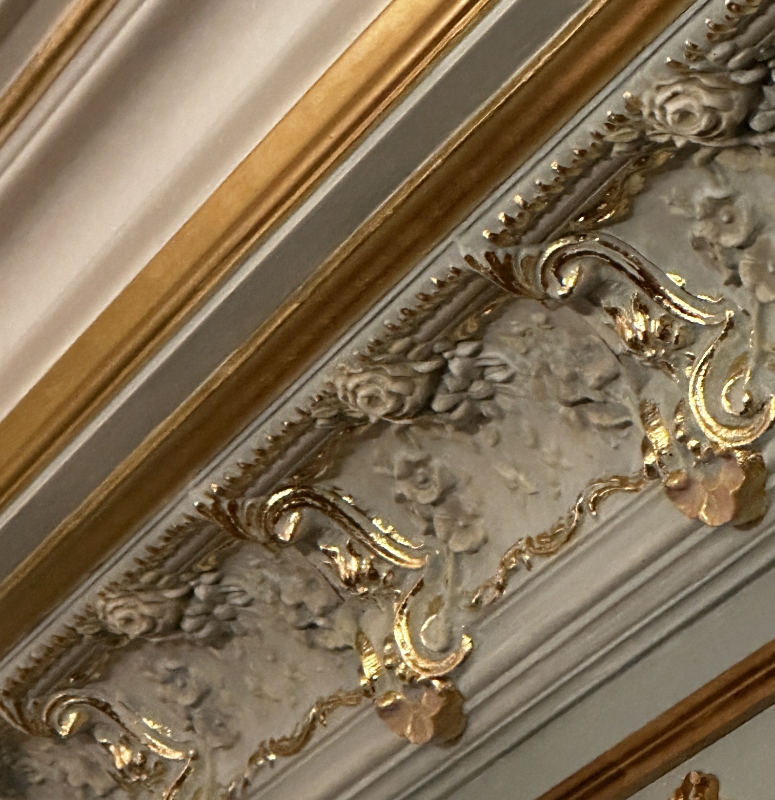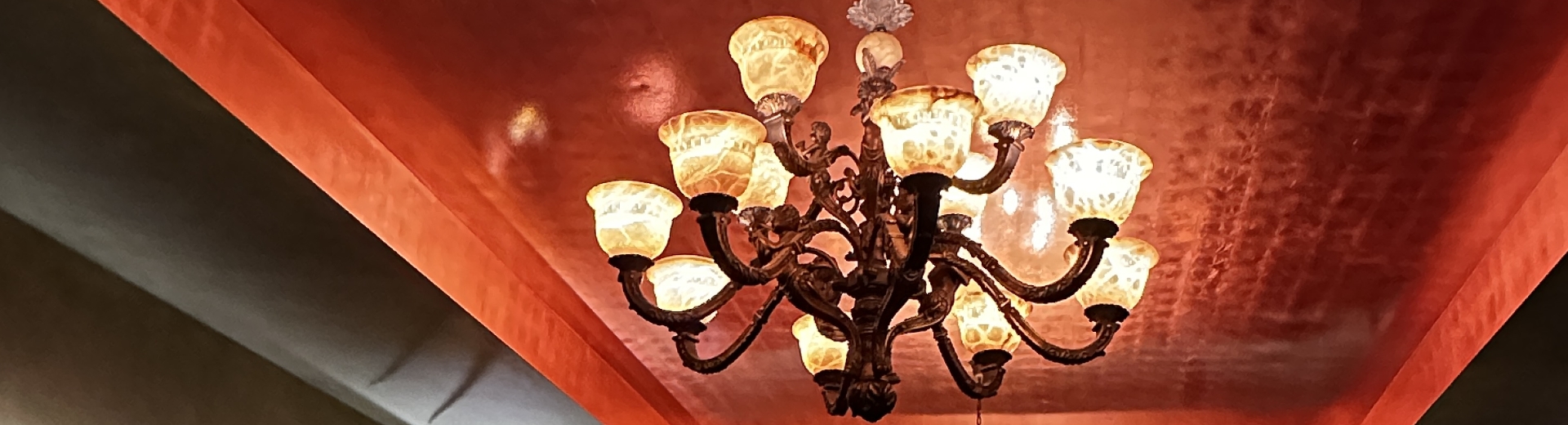
-
 35+ Years Experience
-
 Society of Gilders Member
-
 VCA
Postgraduate -
 International Clientele
Gold on a reflected ceiling plan is easy to draw. Building it raises four questions, in much the same order every time: the substrate, the access, the programme, and what the finishes schedule should say. I am Marcus Walkley, and architectural gilding is most of what I have done for 36 years: gold, silver and copper leaf laid onto ceilings, walls, lobbies and the fixed elements of a building. One commission alone ran to 1,350 square metres of contemporary commercial ceilings for ARM and Heritage Australia.
What the substrate has to be
Leaf is thin enough to take the shape of whatever it is laid on. A ripple in a plasterboard join, a roller mark in the base coat, a dent in a moulding: all of it is still there under the gold, lit from a new angle. So the first conversation is never about metal. It is about the surface: what it is, what condition it is in, and how true it has to be.
New plaster, old plaster, timber, metal, carved mouldings and previously painted work all prepare differently, as does a ceiling patched around services. There is no single preparation specification I can print here: the honest answer changes with the substrate. Tell me what the surface is and what state it is in, and preparation is settled after I have seen it.
Quantities work the same way. The area on the plan is where the calculation starts: relief, coffers, mouldings and returns all change how much leaf a surface takes. Any rate quoted before someone has stood under the ceiling will be wrong in one direction or the other, so the quantities come off the drawings and the surface itself.
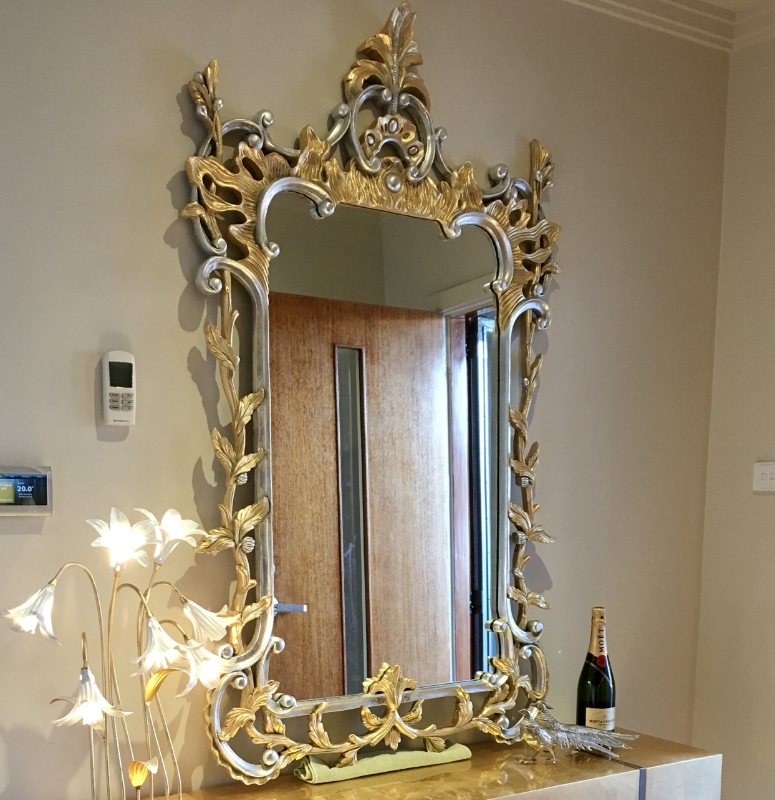
Ceilings, walls and the elements in between
Ceiling gilding behaves unlike any other surface in a building. Nobody looks straight up at a ceiling for long; they see it as the light it hands back. That makes the gild and the lighting design one decision rather than two, and a cove wash across a gilded soffit gives you a different room from a grid of downlights. Feature ceilings in a lobby add scale: the same surface is read from three storeys away and from directly underneath.
Wall gilding is the opposite problem. Feature walls sit at eye level, a metre from someone with nothing to do but wait, often in raking daylight. Laps, seams and the edge where the leaf stops are legible at that distance, so setting out matters as much as laying.
Between them sit the elements the drawings only imply: columns, cornices and mouldings, joinery, sculpture, and the mosaic work that sometimes shares a scheme with gilding. My gilding portfolio shows how the same materials read across those surfaces.
Gold is not the only metal leaf worth specifying. Silver runs cooler; copper runs redder and sits well against timber and stone. Gold or silver? The room usually answers that before I do. Decorative ceilings in a heritage dining room and a new lobby can both be right in gold, and both wrong in it.
Access, programme and the trades around you
Everything you gild overhead is reached from a platform, usually the next thing to resolve after the surface. Scaffold, a mobile tower or an elevating work platform: which one depends on the height, the floor below, and what else the space is doing at the time. Access drives the programme far more than the gilding does, so it is worth resolving at design stage.
I hold a Work Safe OH&S White Card and an EWPA Yellow Card, I have completed Work Safe Construction Induction, and I hold CFMEU membership in Victoria, Queensland and the Northern Territory. It means I can be inducted and working alongside the other trades rather than scheduled around them.
Where the gilding sits in the sequence is the other half. The surface has to be complete, clean and dry before leaf goes near it, and the finished work needs protecting while everybody else finishes theirs. Leaf is laid by hand at the speed a hand works, and it has no tolerance for dust or traffic while it is going down.
Large runs take the time they take. The gold foil gilding in the State Theatre at Arts Centre Melbourne ran for 10 months.
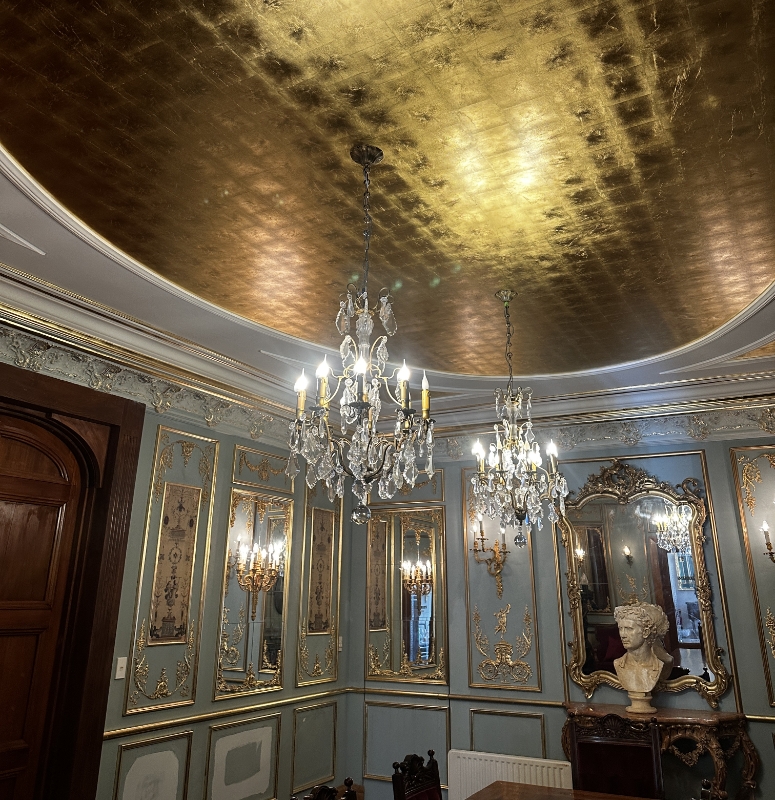
Writing gilding into a finishes schedule
Gilding is often the one line in a schedule that names a material and stops. Four things are worth naming instead.
-
 The metal
gold, silver or copper, and whether one metal runs across every element in the scope.
-
The method
water gilding, one of the most classical and exacting methods, behaves differently from an oil-gilded finish and takes a different amount of time on site.
-
The extent
which planes, which mouldings, where the gilding begins and, more usefully, where it stops. Terminations at a shadow line or a wall junction are where a specification tends to go quiet.
-
The finish
how bright, how burnished, and how much of the surface underneath is meant to show through.
That last one is the one nobody can write down. Burnished, matt and antiqued each cover a wide range, and no two people picture the same thing. The practical answer is to settle it against a physical sample on the actual substrate rather than against an adjective, and to keep that sample where it can be found months later.
Documented that way, gilding sits in the schedule like the architectural finishes around it: named, scoped, approved and measured against something real.
Working with Walkley Art on a specified project
There is no account manager between your drawings and the work. Walkley Art is my own practice, so the person reading your documents is the person on the platform when the leaf goes on.
Membership of the Society of Gilders sits behind that, along with postgraduate study in Fine Art at the Victorian College of the Arts. The specialist training came from Jennifer Bennell, at the Studio of Painted Finishes in Sydney. I have spent most of these years working inside schemes drawn by architects and decorators, here and overseas. The scheme belongs to you; my job is to make it behave in metal.
Across 36 years the contemporary commercial ceilings alone come to more than 11,000 square metres, a career total rather than one job. Much of the built work is in luxury hotels, casinos and public venues; it sits on my commercial portfolio, including the ceilings at Hamer Hall. Guarantees and warranties cover both materials and workmanship, and I guarantee no child labour in the production of the leaf. I work from my studio in Elwood and travel to site, interstate and overseas.
Send the drawings
A reflected ceiling plan, the finishes schedule as it reads today, or a photograph of the substrate: any of those is enough to start. From it I can tell you what the surface needs, where the access comes from, and what the specification should say. If the project warrants it, I will come and look at the space before anything is quoted.
marcus@walkleyart.com, or +61 411 622 711, Monday to Friday between 9am and 5pm.