-
 35+ Years Experience
-
 Society of Gilders Member
-
 VCA
Postgraduate -
 International Clientele
Gold laid over a moulding is not the same job as gold laid across a flat wall. The leaf has to be worked down into every hollow and drawn over every raised edge, and it will split where the form turns sharply. I am Marcus Walkley, I have gilded for 36 years, and modelled surfaces are where most of the difficulty in this trade lives. Malvern sits among the Melbourne suburbs I work in, and my gilding services travel there from a single studio at 143 Brighton Road, Elwood. Gold, silver and copper leaf, laid by hand.
Walkley Art, and knowing when to stop preparing
Walkley Art has been my own practice for all 36 of those years, and the judgement I would put first on an ornamented surface is knowing where to stop.
Preparing a flat wall runs in one direction: keep working until it is even. On a run of enriched plaster or a piece of carved timber it runs in two, and they pull against each other. The ground has to be sound enough to take the metal, and it has to leave the detail as sharp as you found it. Filler and sealer settle in exactly the places the ornament needs to stay open. Push the preparation too far and the bead softens, the undercut fills, and what you were gilding is quietly half a shape less than it was.
There is no method that decides that for you. The call is made on your profile and no one else’s, which is the plain meaning of bespoke gilding on work like this. If you want to know what those years were spent on, the about page sets it out.
How the leaf gets into the hollows
If the surface you have in mind is modelled rather than flat, the leaf goes on in a different order. It is laid over the form first, then pressed down into the hollows with a soft brush, then worked around each member of the moulding in turn. The sharp edges are where it breaks, and a break is not a failure. A small piece of leaf is laid into the gap, which is called faulting in, and once the surface is dressed back nobody finds it again.
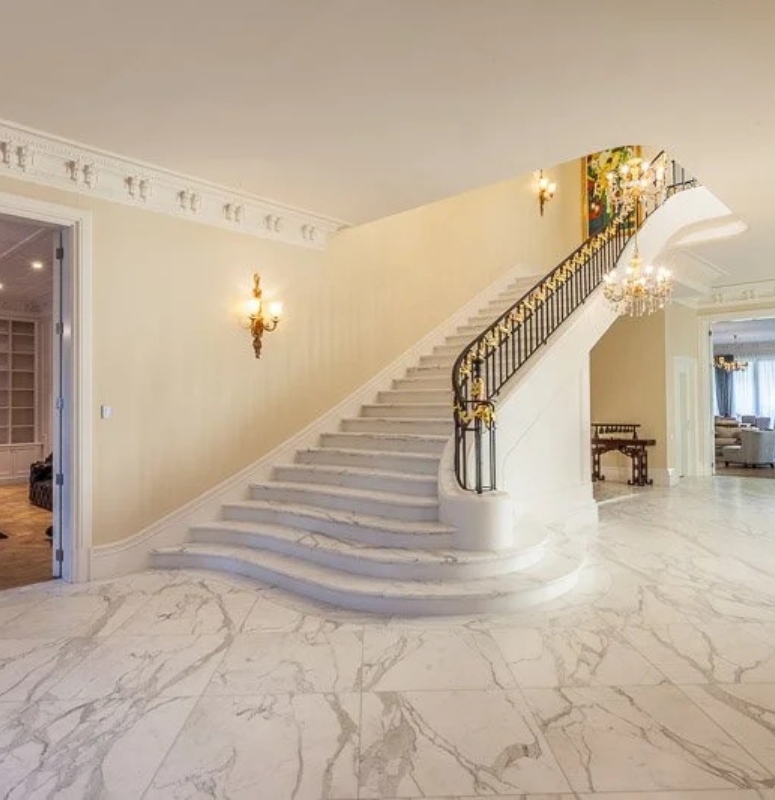
The City of Stonnington describes suburbs such as Malvern as having heavily protected streetscapes of Victorian and Edwardian housing, and interiors built in those years usually carry more modelled surface than flat: a run of cornice, a centre rose, panelled joinery, a carved mantel.
Decorative gilding on a plane works as a field of reflection. On an ornament it works through shadow, because the raised parts take the light and the hollows keep it, so gilding a moulding sharpens what the form was already doing. Gold leaf holds that indefinitely, since it does not tarnish. Silver and copper keep moving after they are laid unless they are sealed, and inside a deep hollow that change is harder to see coming. Surfaces of this kind sit in the gilding portfolio.

What decides how long the work takes
Scope on ornamented work follows the profile. A metre of deep enriched cornice carries several times the surface a metre of flat wall does, and every face of it is covered by hand. Two rooms of the same floor area can sit a week apart for that reason alone.
So the numbers worth sending me are the length of the run and roughly how deep and how enriched the profile is. A photograph taken square on to the moulding says more than either of them. There is no standard unit for any of this: custom gilding on a modelled run means the scope is built out of what your profile actually is, which is why a length and a photograph get us further than a floor plan does.

One element is a whole job
An ornament is a self-contained piece of work. A centre rose, one mantel, the moulding around a single opening: each has its own edges, so each can be gilded, finished, and left with nothing around it looking half done. Nothing about the work obliges you to settle a whole room at once.
That is often the sensible way into it. One element takes the metal, and it stands as finished work rather than a down payment on a scheme, so the rest of the room can wait a year or ten.
Whichever element you have in mind, marcus@walkleyart.com and +61 411 622 711 both reach me directly.